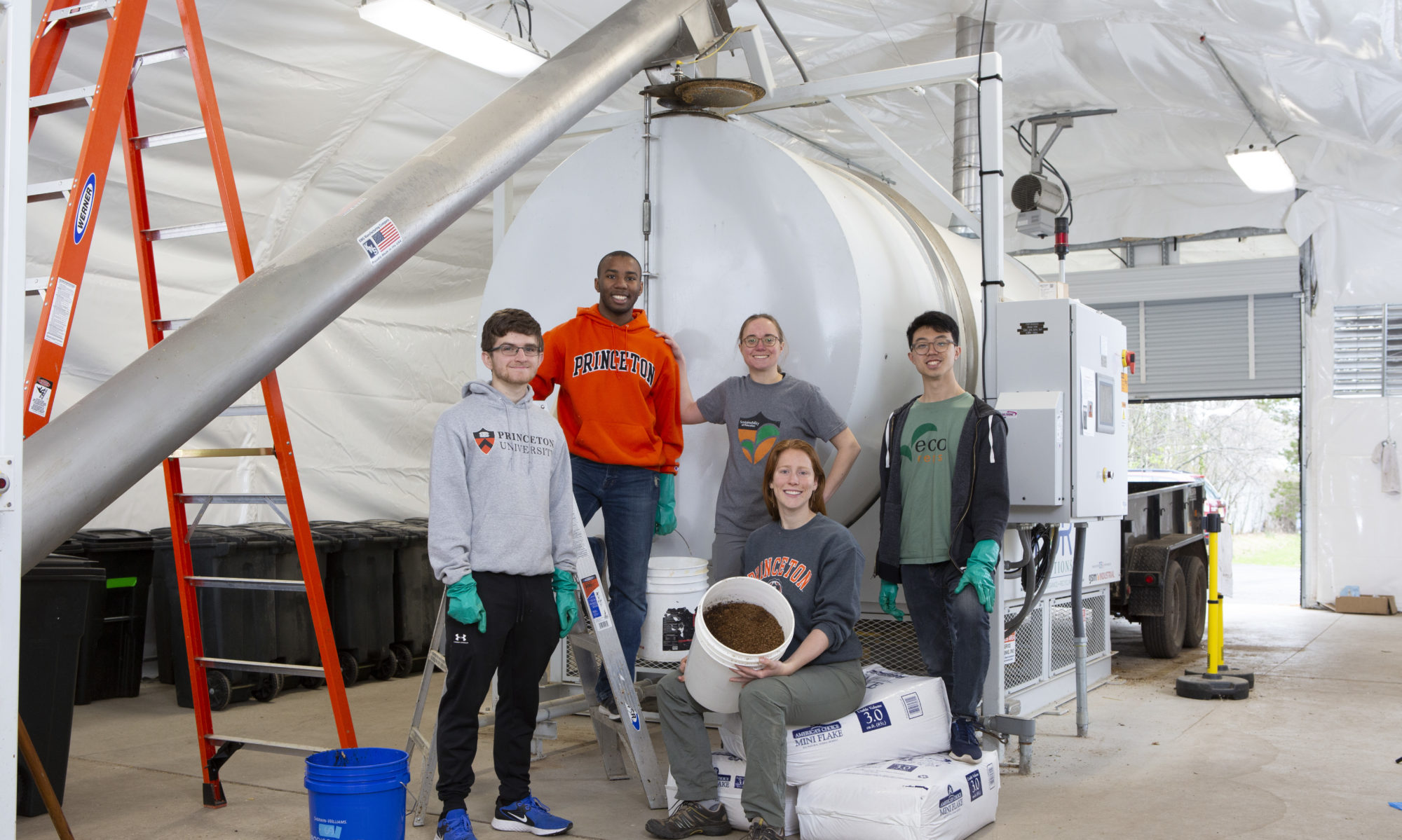
In addition to supporting the University’s food scraps diversion program and zero waste goals, the SCRAP Lab serves as a living laboratory for multi-disciplinary investigations into organics recycling. This section provides information on past and current research projects as well as suggestions for future research.
PAST PROJECTS
New Jersey Department of Environmental Protection Recycling Enhancement Award Research Grant (2023-2025): Advancing institutional recycling goals through compostable plastic product and user testing
This project’s goal was to understand the current waste stream of the university, whether compostables were a viable alternative given the current methods of composting, and determine whether post-consumer food waste with compostable products could be collected without significant contamination. Learn more. Full report available upon request.
Campus as Lab Innovation Fund projects
-
- Professor Xinning Zhang and her lab are analyzing how the microbial communities present in the composting system can shed light on how inputs and operating conditions affect the conversion process and in turn compost quality. Learn more.
- A study led by Professor Daniel Rubenstein is analyzing the use of S.C.R.A.P. Lab compost as a strategy to transition campus farmland toward more sustainable practices.
A USDA/NSF research grant awarded to Professors Anu Ramaswami and Z. Jason Ren evaluated the role of small-scale, in-vessel composting in reducing waste and creating a more sustainable and resilient urban food system. Learn more.
Professor Satish Myneni and his team have studied how different feedstock types and combinations impact the rate and quality of compost formations. Learn more.
OPPORTUNITIES
Help us study the sustainability implications of creating a soil amendment via aerobic in-vessel composting through one of the below research topics:
1. Not all compost is created equal. The bacteria and fungi profile and diversity can vary depending on the quality and type of inputs into the system. Test different input ratios of carbon to nitrogen and/or different carbon sources (e.g. wood shavings vs. wood chips vs. cardboard). Study the microbial communities over time based on feedstock type. Which combinations or sources result in finished compost that is most effective at…
a. Removing toxins or other pollutants from the soil?
b. Increasing the water holding capacity of soil/preventing erosion?
c. Promoting soil carbon sequestration?
d. Enhancing productivity and/or growing nutrient-rich and high-quality fruit and vegetable crops?
2. Experiment with different compost teas and extracts. What compost : water ratio is best at protecting plants from fungus or diseases?
3. Test the feasibility of the composting system in breaking down a range of bioware to inform University purchasing decisions around non-plastic eating utensils, plates, cups, take-out containers, etc. .
4. Participate in a multi-year comparative analysis of using finished compost from the SCRAP Lab versus chemical fertilizers on University grounds.
5. Conduct an ethnographic study of different people’s experience and/or relationship with composting and soil amendments
6. What are the economic impacts of returning uneaten food to the soil? Quantify the positive externalities and ecosystem services provided through compost applications.
7. Conduct a Life-Cycle Analysis (LCA) to evaluate the full range of sustainability implications on emissions, water use, etc. of using this type of technology versus other conversion processes.
7. Assist with graphic design and communication materials for site tours
Please contact Food Systems Project Manager, Gina Talt ’15, with any questions or to express interest in operational or research opportunities.